18.1.11

Dyslexic Media: All this huff and puff over Hu?

American Media arranges a political hit job on Chinese President, Hu Jintao prior to his arrival to Washington. 

Mr. President, this is what they are ready to offer for Arizona.
Today, The New York Times and Washington Post ran stories about how Hu Jintao is politically weak and is hardly able to control his own government. A scary thought. Only, it reeks too much of a conspiracy theory coming out of a country that was just shown king-sized finger by Hu Jintao’s regime...


15.1.11

Dyslexic Media: My rebuttal to The Economist rebuttal

Last night I wrote post about New Delhi lacking a China Policy and an appeal to get one. As it turns out, (pointed out by Achal K) The Economist had anticipated my post and published a rebuttal to my argument almost a month ago. I tell you, these Economist reporters have nothing better to do than to keep guessing what bloggers would write in the future and trying to bring them down.

Anyways, their article about “how Indian attitude towards its bigger neighbor is hardening” was a usual cut-and-paste job. Five examples of Indian assertiveness against China in 2010 had been shabbily slapped together to prove the case. After reading the article, only two questions came to my mind: What are they smoking down at The Economist office and can I get some of that? (I know I used that joke once already this month.) The examples put together paint picture of India as a sheep not a tiger. As always, the magazine was terribly wrong about India. You may not believe me, but they do this all the time.

Hey India, get a China Policy already


Since 1962, Indian policy in response to China flexing its muscle has been “see no evil, hear no evil”. Every once in a while, under media pressure, the government may wave around the Tibet card, but mostly all India wants to talk about on the issue of China is economy, factories and environment. As for issues like rising Chinese military power, Chinese support to Pakistan or frequent episodes of China making things awkward for India, there is only silence from New Delhi.

This week, China pulled the stapled visa trick again – this time on a couple of Arunachal Pradesh athletes. Once again, China said that since they do not consider Arunachal a part of India, they can’t recognize the Indian passports that athletes were carrying. Quickly the Indian Ministry of External Affairs swung into action and released a press briefing saying, “We have seen media reports on issuance of stapled visas...We have unequivocally conveyed to the Chinese side that a uniform practice on issuance of visas to Indian nationals must be followed.”  Yeah, because that has China trembling like a leaf.

5.1.11

#9 China tries Jedi mind tricks on Nobel Prize Committee


What is the best way of dealing with a political dissident receiving a Nobel Peace Prize? It’s very similar to the five steps to deal with death- Denial, Anger, Bargaining, Depression and Acceptance- minus the last step. At least that’s what Beijing thinks. When the Nobel Peace Prize was awarded to jailed Chinese dissident Liu Xiaobo this year, Chinese Government went into an insane drive to destroy world’s most prestigious award. 

From blocking out the news from the internet(!) to arranging a political hit job on Xiaobo, threatening the Nobel Prize Committee, making up its own version of Nobel Prize, to finally pressurizing  16  countries (including Russia and Saudi Arabia) to boycott Nobel Prize Ceremony, China used every possible tactic in Oppressive Regime & Evil Dictator Handbook. For some reason I am not looking forward to a world dominated by the Chinese Dragon.

Of course, Chinese attempt to deny (read defy) reality was nothing compared to their southern neighbor…

26.10.10

Do we know anything about the two future bosses of the world?


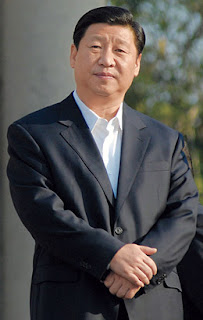
So, the Chinese politburo has chosen its next leader. And we know nothing about him. Xi Jinping at 57 has been announced (in characteristically sneaky way) as the leader of China to succeed Hu Jintao in 2012. This man is going to be the emperor of China, and the way China is going, one of the two most powerful people in the world, along with the American President. Immediately after the announcement Time Magazine, The Economist, Foreign Policy and all the other major new organizations in the world quickly published his profile. And they all had the same thing to say - we know nothing about this guy. 

All we know about this enigmatic personality is that he oversaw the Olympics preparation in Beijing, at one time used to run Shanghai, has married a very popular Chinese singer and is son of a communist who was denounced during the Chinese Cultural Revolution of 1966. That's it. That's all we know about the man who in two years time might be in charge of the biggest economic and military powerhouse in the world! Lovely.

On the other hand, we may not know anything about the Yin to this Yang as well - the American President of 2012. From what is now becoming apparent, Obama is not going to survive till the next term. And the Democrats don't seem to have anyone better. So most likely the Republicans are coming back into White House in the 2012 Presidential Elections. According to the current polls, two favorites of Republicans are Sarah Palin and Mitt Romney. I feel that Romney is a little faint-hearted, always worrying about what if he loses. Therefore, it is likely that he might drop out of the election race if he feels that he can not win even before the campaigning. Palin on the other hand, is gonna run and gonna run big. Moreover, the new Tea Party movement has garnered her a lot of support and she might actually end up running the United States.

Now with Sarah Palin the problem is not what we know about her - we know way too much with her family popping up on TV all the time - but what she knows about herself. She is a blank slate. So what she will do once she is the President is anyone's guess including her own. 

This is the scary situation. We do not know anything about the two most powerful people our world may have in 2012. May be the Mayans were right.

Images: Xi Jinping, Sarah Palin
Image Credit: Time Magazine, Shank bone

13.10.10

Japan is considering to remove weapons export ban, or is it?

Two days ago, the Japanese Defence Minister, Toshimi Kitazawa told U.S. Secretary of Defense Robert Gates that Japan is going to reconsider its ban on weapons export. A day later a cabinet level secretary from the Japanese Government confirmed it in a press conference. And now unconfirmed reports are coming in of the Japanese Prime Minister having denied to review the forty-year old Japanese law.

Why all the fuss? Since 1967, Tokyo has effectively banned arms export to rest of the world through a legislation. Japan (along with Costa Rica) is one of the world's only two countries which has a pacificist clause in its constitution. There are laws in Japan which ban the country from going to war, keeping an army (of course, Japan has a 250,000-strong "Self Defence Force") or ever tinkering with a nuclear weapon.

However, in recent years there has been a strong minority emerging in Japan that advocates throwing away these bans and develop some strong muscles so that China can't bully Tokyo around. The Americans, who have provided Japan with security guarantee since World War II, would also like to see Japanese chipping in instead of taking a free-ride on American military might. Many conservatives in Washington see a huge expense coming the US way in the next twenty years as the cost of containing the Chinese military machine. They would obviously like to see someone sharing the bill.

With the Chinese coming off as more threatening in the past few months with their naval activities in the Pacific and North Korea constantly in the "crazy" gear, it is logical that the Japanese are worried about their security. Some in Japan have gone to the extent of calling the government to develop its own nuclear weapons, a view that Americans share.

Therefore, the removal of arms export ban is critical as it can been seen as the first step towards Japan reverting to its martial roots. A land of ninjas and Samurais, I am sure Japan has the capacity. The question is do they have the will?

Image: Japanese Kamikaze pilots of World War II
Image Credit: The Telegraph

5.10.10

Mozambique: Another theater for India-China trade war

I will preface by saying that I might be wrong on this, but seems to me that India is gearing up to protect its economic position in Mozambique as China tries to big-foot its smaller neighbor out of the African continent. A couple of days ago, India extended a credit line of US$ 500 million to Mozambique while Mozambican President was visiting New Delhi. Considering that until last week, the total amount of money extended through previous six lines of credit was only US$ 140 million (source: MEA), this figure is considerable jump. Why is it so?

It seems that India and China both are vying the extensive coal deposits in Mozambique. In the past India, along with Australia, has dominated the Mozambican coal reserves. TATA Steel and SAIL, both have extensive interests in the country. Traditionally, China has shown little interest in Mozambican coal and gas reserves, only importing agricultural products and fisheries from the country. Although the trade relations is on the meteoritic rise, China has restricted itself to importing food and selling machinery. That is, until three months ago. In June, 2010, Chinese steel companies announced their plans of entering Mozambique and investing billions of dollars in developing the coal fields in the country.

Obviously, the Chinese entry into Mozambican coal business is likely to prove a tough competition to the Indian steel companies just like the Indian oil companies have been outbid across the globe by the Chinese. In a reactionary strike not to lose dominance in another African country in race to get raw materials, India seems to have replied with doling out money to the Mozambican government.

Of course, India cannot match China in the amount of aid given. What it can match the Chinese is in how the aid is given. The Chinese are infamous in Africa for not allowing technology transfers and training to the Africans. India can win some favors in the African markets by treating them better than the Chinese in this respect.